Guitar dead spots live on your neck's resonances
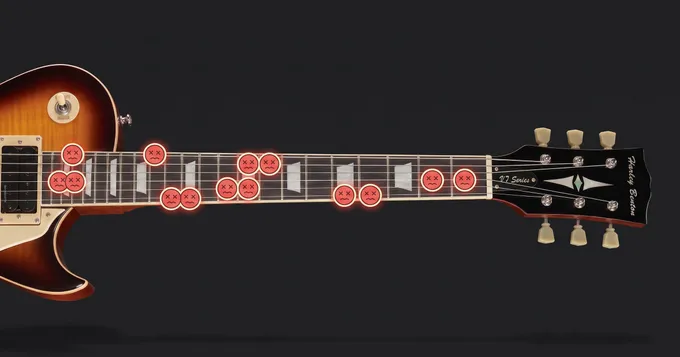
Play up the G string of a Harley Benton SC-450 Plus, one fret at a time. The open G rings, frets 1 and 2 go quiet in about 60 per cent of the time their pitch should allow, and a few frets higher the string rings long again. We have found a dead spot: a note whose sustain falls well short of the notes around it.
Almost every solid-body electric guitar has a few. They are not random and not a defect of one instrument. They sit at the frequencies where the neck itself likes to vibrate.
The neck has resonances of its own
A guitar neck is a long, fairly flexible beam bolted or glued to a heavy body, with a headstock hanging off the far end. Like any such beam it bends most easily in a few patterns, its modes. In the lowest one the neck flexes in a single arc; in the next it bends into an S; the one after that has three half-waves. Each pattern has nodes, points that hardly move, and stretches between them that move a lot.
Each mode has its own frequency, and the more bends in the shape, the higher it is. Shake the neck at one of these frequencies and it swings readily in that mode’s shape; shake it at a frequency in between and it barely responds.

The picture is a simple beam model, not a measurement of any particular guitar: real necks taper, twist and have a truss rod, and the body is not a rigid block. It shows the shapes, not the frequencies. On the guitar measured below, the neck’s strongest low modes sit around 184–196 Hz and 432–455 Hz. That is right in the middle of the fretboard’s range.
Why a resonant neck steals your sustain
A string rings because the energy you put in with the pick has nowhere to go. Both ends of the string, the fret and the bridge saddle, are meant to be stiff, heavy supports. Each cycle the string pushes on them, and if they don’t move, the energy stays in the string.
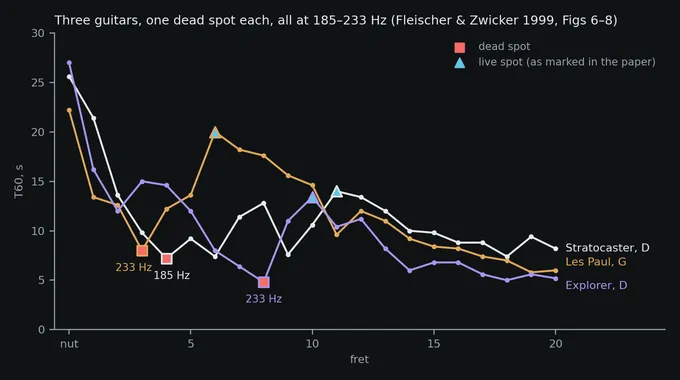
Helmut Fleischer, who measured this on basses and guitars at the Universität der Bundeswehr München in the late 1990s, put a number on how much a support gives: its mobility, how fast the point moves for a given push at a given frequency. The part of it that matters here is the conductance, the real part, which says how much power flows out of the string into the wood instead of bouncing back. Away from a neck mode the conductance at a fret is small. At the frequency of a mode, the neck is easy to push and the conductance at a fret that sits on a moving part of the mode jumps. A note at that frequency drains into the neck and dies early. Helmut Fleischer and Tilmann Zwicker (Investigating Dead Spots of Electric Guitars, Acustica · acta acustica 85 (1999) 128–135) measured both the decay and the conductance at every fret of a Stratocaster, a Les Paul and an Explorer, and the dead spots fell where the conductance peaked.
Two things follow, and both show up in measurements:
- It is about frequency, not about the note’s name. The same pitch played on another string, at another fret, tends to be weak too, because it hits the same neck mode.
- Position still matters. A fret near a node barely moves even at the mode’s frequency, so the same pitch played there can survive. That is why a dead spot is a handful of positions, not every note of one pitch.
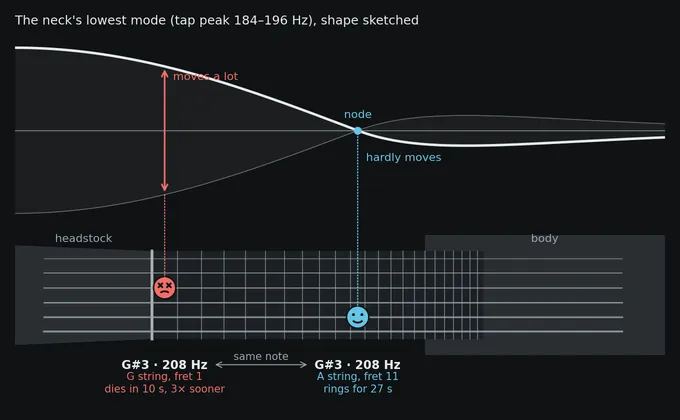
It also matters when the energy goes. A neck mode does its damage early: in the first moments after the pick the string feeds the neck, and the note’s level drops quickly; what remains then decays at a more ordinary rate, just from a lower start. That is the “dead” feel: the note does not fade, it collapses and then hangs on quietly. And because a plucked note is a stack of harmonics, one harmonic can land on a neck mode while the fundamental does not. The note then keeps ringing but loses part of its colour.
The same thing, measured: a Les Paul, a Stratocaster and an Explorer
The Les Paul in the 1999 study lost the G string’s 3rd fret (233 Hz), while the 6th fret (278 Hz) rang more than twice as long, although it is three frets higher. The Stratocaster had its dead spot on the D string at the 4th fret, 185 Hz, and the Explorer on the D string at the 8th fret, 233 Hz. Three guitars, three dead spots, all inside the same 180–240 Hz neighbourhood.
A Harley Benton SC-450 Plus, measured
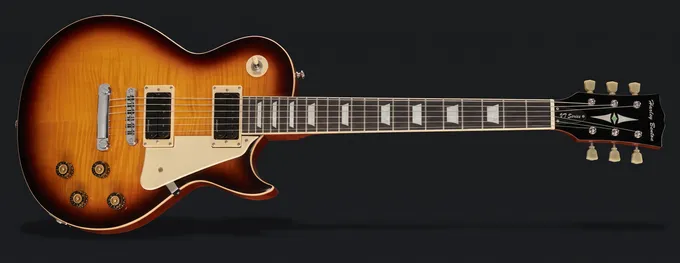
We scanned every note of a Harley Benton SC-450 Plus, a single-cut guitar, string by string and fret by fret, plucking each note at least three times, and measured how long each one rings. Bass strings ring longer than treble ones and low notes longer than high ones, so a raw sustain number says little. Each note is compared with the trend of its own string instead: 1.0 is “as long as this string normally rings at this pitch”, 0.5 is half that. The same goes for each harmonic of the note: the second, third and higher harmonics each get their own trend.
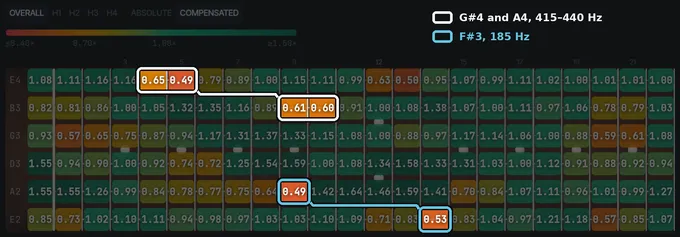
Most of the map is green. The short notes are few, and they are not scattered at random: the same pitch comes out short on neighbouring strings. F#3 (185 Hz) is short on the A string’s 9th fret (0.49) and on the low E’s 14th (0.53). G#4 and A4 (415 and 440 Hz) are short on the high E’s 4th and 5th frets (0.65 and 0.49) and on the B’s 9th and 10th (0.61 and 0.60). That is the first point from earlier: it is the frequency, not the note.
A plucked note is a probe: its fundamental and each of its harmonics test the neck at one frequency, at the fret where the note is played. Fretoscope’s dead-spot analysis looks for frequency bands where these probes come out short more often than chance would allow. On this guitar it finds three: 160–227 Hz, 416–473 Hz and 648–707 Hz. From here on the numbers are per probe, so a note’s fundamental can read a little differently from the whole note on the map: the A string’s 9th fret is 0.49 as a note and 0.45 for its fundamental alone.
Then we muted the strings, tapped the neck with a small hammer at the 5th, 10th and 13th frets, and recorded how the wood rings. The tap shows where this neck resonates: peaks at 184–196 Hz, 432–455 Hz and a group at 683–715 Hz. Each of the three bands sits on one of them. Here is the tap at the 5th fret with the high E string’s notes laid over it:
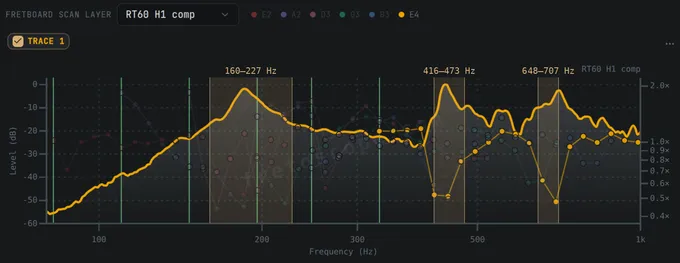
The fundamentals of the high E string’s notes ring at their trend, except under the two tap peaks: around 415–440 Hz (frets 4 and 5, 0.52 and 0.51) and at 698 Hz (fret 13, F5, 0.48).
The G string from the introduction is in the lowest band, and it looks much like the G string of that Les Paul. Its decay time per fret is on top, the SC-450’s in the two panels below. The study gives T30, the time for the note to fall by 30 dB; we measure T60, the fall by 60 dB. T30 there is read off a straight line fitted to the decay, so the Les Paul’s T60 is twice its T30, and that is what the top panel shows. The two guitars, their strings and the two methods still differ, so compare the shapes of the curves, not the seconds.
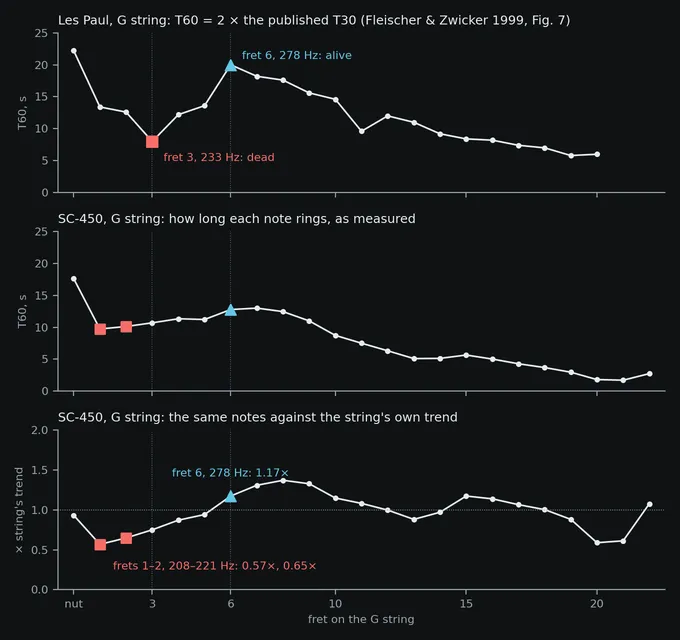
Measured in seconds, the SC-450’s G string mostly gets shorter as the notes go up, and the dip at frets 1 and 2 is easy to miss. Against the string’s own trend it stands out: frets 1 and 2 (208 and 221 Hz) ring 0.57 and 0.65 of what the string should give at that pitch, fret 3 (234 Hz, the Les Paul’s dead note) 0.75, and fret 6 (278 Hz, its live note) 1.17. Two guitars of the same design, measured more than 25 years apart, lose their G string in the same few frets near the nut.
Where on the neck matters
The 416–473 Hz band shows the second point from earlier, that a dead spot is a handful of positions and not every note of one pitch:
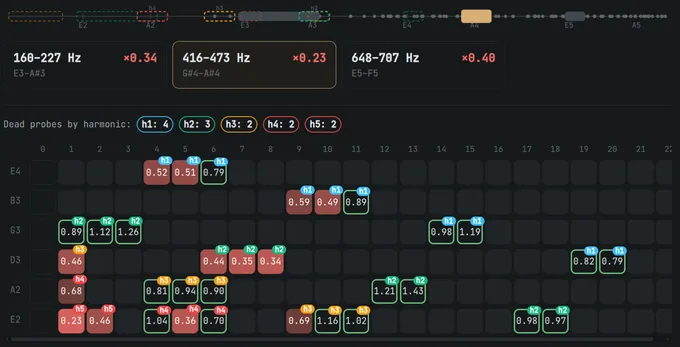
Between frets 4 and 10 the band’s probes are dead on four strings: the high E at frets 4 and 5, the B at 9 and 10, the second harmonic of the D at 6 to 8 (down to 0.34). From fret 12 up, all eight probes in the band ring at 0.79 to 1.43 of their trend. The tap agrees: struck at the 5th fret, the 432 Hz peak is the strongest in the spectrum; struck at the 13th, it sits about 7 dB below the strongest.
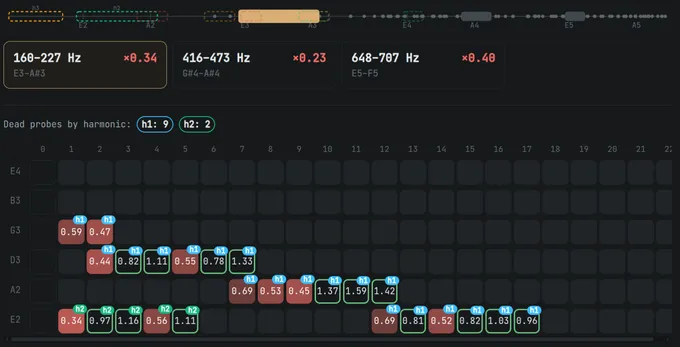
The lowest band behaves the same way. Below fret 10, 9 of its 16 probes are dead; from fret 10 up, 2 of 9. On the A string the change is abrupt: the fundamentals of frets 7 to 9 ring 0.69, 0.53 and 0.45 of their trend, those of frets 10 to 12 ring 1.37, 1.59 and 1.42. Struck at the 5th fret, the neck’s 184–196 Hz peak is within a few dB of the strongest one; struck at the 13th, it is more than 30 dB down and barely there.
The highest band goes the other way. Here is the tap at the 13th fret, with the same high E string over it:
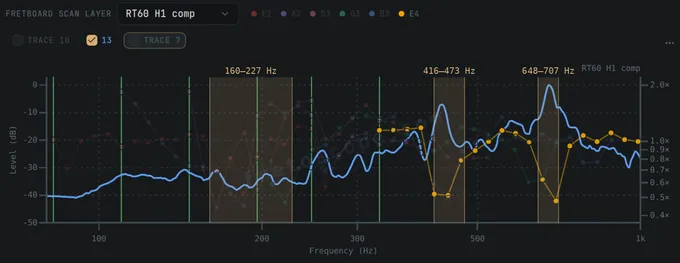
Struck at the 13th fret, the 683–715 Hz group is the strongest peak of the whole tap, and that is where F5 dies, on the high E’s 13th fret. The band also catches harmonics low on the neck: at the G string’s 3rd fret the third harmonic, 701 Hz, decays at 0.53 of its trend, so the note keeps ringing but loses part of its colour.
A harmonic can also explain a short note. The low E’s 1st fret (F2, 87 Hz) rings short. Its fundamental is only a little short, at 0.71 of its trend, but its second harmonic, 175 Hz, falls into the lowest band and dies at 0.34. Our taps show no peak near 87 Hz, but they were struck at the 5th, 10th and 13th frets only; a low mode that moves mostly near the nut or the headstock could hide from all three, so it is not ruled out.
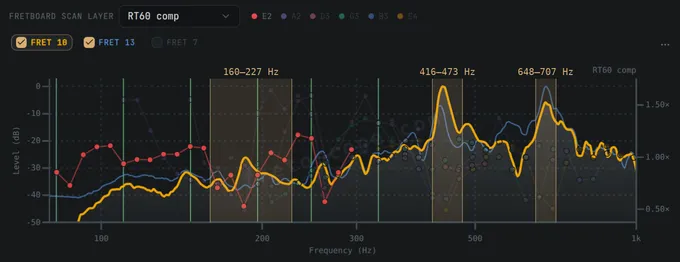
The low E above fret 10 is the exception, and by frequency it fits the tap almost note by note. Its 12th fret (165 Hz) sits on the smaller peak just below the main one and rings 0.69 of its trend; the 14th (185 Hz) sits on the main peak and drops to 0.52; the 13th, between the two, recovers to 0.81. At the 11th fret (155 Hz), below both peaks, the string is back at its trend.
These frets are above the 10th, where the neck moves less, but less is not nothing. Struck at the 10th fret, the neck still rings at 186 Hz, about 26 dB below its strongest peak, and the low E’s 14th fret dies right on it. A second small peak sits at 260 Hz, and the low E’s 20th fret, C4 at 262 Hz, rings 0.57 of its trend. The same C4 is short on the A string’s 15th fret too (0.70), while lower on the neck, on the B, G and D strings, it rings at 0.81 to 1.00. Between the two peaks, at the 16th to 19th frets (208–247 Hz), the low E rings at or above its trend.
Dead spots also come back. We scanned this guitar two months earlier with the same method; 7 dead positions are the same in both scans, against fewer than 2 expected by chance.
Why other guitars have them too
The Stratocaster, Les Paul and Explorer from the paper had their dead spots between 180 and 240 Hz; the SC-450’s lowest band is 160–227 Hz. Necks of similar length, mass and stiffness end up with similar modes, so similar pitches turn up dead on different guitars. What differs is the exact frequency, how sharp the resonance is, and which frets sit on its moving parts. A stiffer neck pushes its modes up; more mass, a heavier headstock for one, pulls them down.
Can you fix a dead spot?
You can move it; removing it is harder. Anything that changes the neck’s mass or stiffness shifts its modes: a clamp on the headstock, a different set of tuners (the SC-450 in this article has had its stock tuners swapped for slightly heavier locking ones, which may have pulled its modes a little lower; we did not measure it before the swap), a different neck. A dead spot belongs to a mode, so when the mode moves, its dead spots move with it, to other pitches and other frets.
The useful first step is knowing where your guitar’s dead spots are and which neck resonance they belong to. That is a map of the whole fretboard plus a tap test, and Fretoscope does both: the scan with the guitar plugged into an audio interface, the tap test with a phone’s microphone. Scan your guitar. How to do it step by step, and how to read the result, is in How to measure guitar dead spots and find the cause.